Who would want to be a lapsed donor?
Donor acquisition is difficult and costly. Reactivating lapsed donors is difficult too, but it is usually more cost effective. Recently, a French telephone fundraising agency were asked to engage with a group of lapsed donors, by picking up the phone and having a chat. This story explains what happened next.
- Written by
- Clément Martin-Monneret
- Added
- October 01, 2010

What happened when a Paris training institute picked up the phone?
In April 2026, a Catholic training institute in Paris handed us 212 supporters who had stopped answering.
They had given once, some more than once, then gone quiet. The most recent had been silent for twelve months. The oldest for five years.
The institute hadn’t given up on them. They still received the newsletter, the appeal letters, the emails. Every campaign went out to them the same as to everyone else.
To no effect. According to the institute, this segment hadn’t produced a single gift despite the written reminders.
Most fundraisers will recognise this. The names sit in the database, cost almost nothing to keep and bring in nothing. Sooner or later, someone suggests deleting them.
Alliance Donateurs picked up the phone instead.
What we did, and what we ruled out
Alliance Donateurs is a French agency that reactivates lapsed donors by phone. One of our callers worked this file, over one week, call backs and rescheduled conversations included.
There was no script. There was a brief: what to raise, what to avoid, where the lines sat. Everything else belonged to the conversation.
No ask in the first few minutes. The opening half of every call was for thanking the donor for what they'd already given and finding out what had made them give in the first place.
A no ended the call. Not softened, not worked around. Ended.
This isn't delicacy. French donors are particularly quick to bristle at anything that smells of selling, and a supporter who’s pushed doesn’t just decline: they detach from the cause. Ken Burnett puts it better than we can: he’s never met a donor who wants to be marketed at. Every charity has a marketing department. No donor has ever asked to become its target.
Three things we learned
1. Hire fundraisers, not telesales
The caller who worked this file doesn’t come from telemarketing. He comes from fundraising, like the rest of our team. We train them ourselves, and what we teach isn’t objection handling. It’s listening.
The distinction matters more than any script. Someone out of a call centre has spent years learning how to steer a conversation to its close. Someone out of fundraising has spent years learning that the relationship is the asset. The first has to unlearn most of it. The second only has to learn the phone.
We call them Donor Managers, which is roughly what they do.
2. A caller who understands the cause has a different conversation
On a cause built on conviction rather than general goodwill, someone who genuinely grasps what’s at stake has a conversation the donor recognises as real. When a donor explains why the cause matters to them, an interlocutor who shares the reference doesn't need it spelled out, and can answer it honestly instead of echoing it back.
In this campaign, the caller shared the faith of most of the donors he spoke to. That’s not a hiring criterion for us, and it isn't a sales technique. It was a circumstance, and it helped.
It doesn't excuse skipping the training or the listening. A caller who shares a donor’s convictions but talks over them will fail just the same.
3. These donors hadn’t turned away from the charity
We logged the reasons people declined. The one that came up most, by a distance, was financial difficulty.
Almost no one cited a loss of confidence in the institute. Almost no one questioned how their money had been used. They’d stopped giving because their own circumstances had changed, and the years had passed without anyone checking in.
For a charity convinced it had been abandoned, this is the single most useful thing the campaign turned up, and it’s worth more than the money raised. These files aren’t full of people who left. They’re full of people who went through a bad year, and no one ever spoke to them again.
The call that says it all
One donor explained that he was drowning in emails and had come to feel that everyone just wanted his money.
Our caller didn’t argue and didn’t pitch. He asked how the donor was doing, then why he'd supported the institute in the first place. He told him what that gift had made possible. Only then did he mention a current project, close to the one the donor had funded years earlier, and what it needed.
The donor cut him off.
‘How can I help you?’
No one had asked him anything. Our caller wrote to me the moment he hung up, still struggling to believe it himself.
The whole method sits in that one call. The donor made the ask.
The numbers
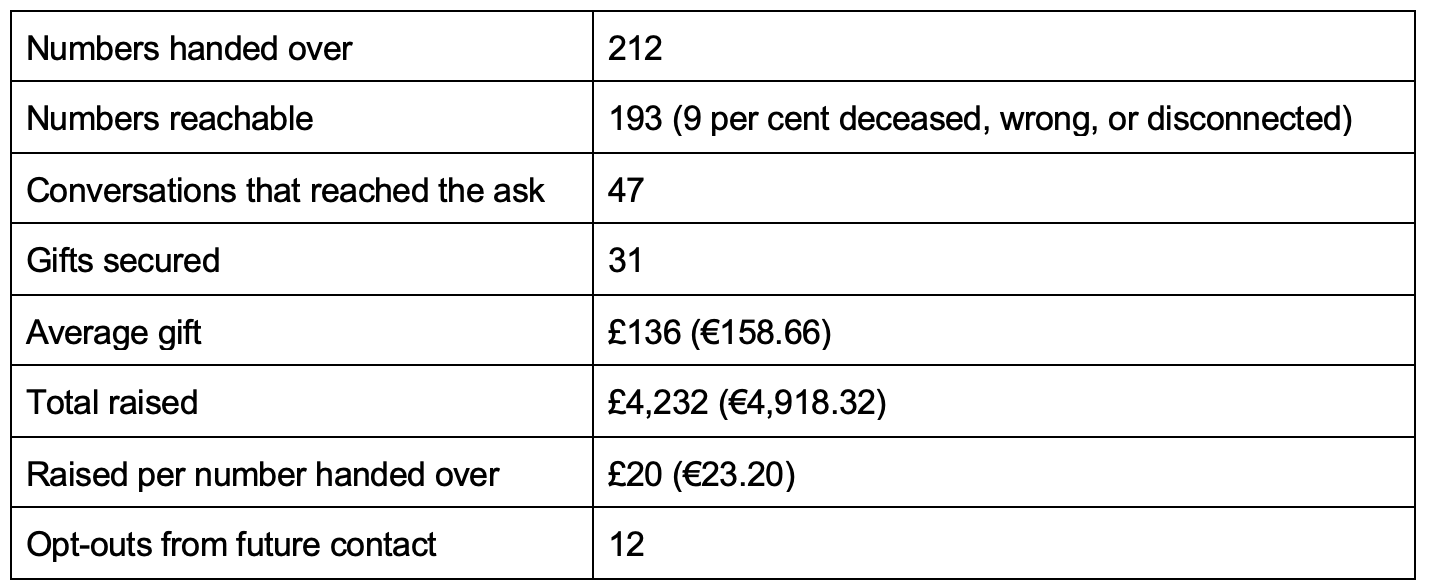
Thirty-one gifts from 193 reachable numbers, 16 per cent, from people who hadn't given in one to five years and on whom the written channel had stopped working entirely.
Of the 47 donors who had a full conversation, two in three gave. That looks implausible until you read the line above it: only a quarter of the reachable numbers ever got that far. The rest didn't pick up, hit voicemail, or declined before the conversation reached that point. The filtering happens early, and someone who accepts a real conversation about a cause they've already supported has covered most of the distance.
The figure we care about most sits elsewhere: these donors gave, on average, 42 per cent more than their last gift.
One caller, one week, 193 reachable numbers and their call backs. That pace isn’t a constraint we work around. It's the method itself. These conversations don’t run at volume.
What we can’t prove yet
Two figures are missing from this account, and honesty requires giving them.
The first: 12 donors asked never to be called again. That’s the cost of the method, and no method is free of one.
The second is more awkward for the argument that follows. Everything below rests on a donor’s value over time: the second gift, the move to a regular direct debit, the eventual legacy. This campaign is four months old. We know what these thirty-one donors gave once. We don’t yet know what they’ll give next.
Ask us again in a year.
Why it’s also the better economic decision
There’s a purely moral version of this argument. It's true, but it isn't the strongest one.
In an article on his own site, Ken Burnett tells a story about his mother. She'd supported ten charities for most of her adult life. Near the end, he found a stack of their envelopes at her house, unopened. When he asked why, she said: ‘They're always shouting at me. Always telling me what to do.’
She died soon after. She left a legacy to none of them.
Ken’s mother wasn’t a lapsed donor. She was a loyal supporter who’d stopped listening, because for years no one had told her anything worth hearing.
That’s the thesis Ken Burnett has argued for forty years: treat your supporters well and they stay. They move from one-off gifts to regular giving, they give for longer, and when they write their will, they remember you.
According to an experiment widely cited in the sector and attributed to Penelope Burk, board members called a segment of donors within 24 to 48 hours of their gift, with an instruction that bordered on heresy at the time: ask for nothing, just say thank you. Giving from that segment is said to have risen by 39 per cent the following year.
Do the sums from the charity’s side. A £136 gift squeezed out of someone who never gives again is worth considerably less than a £100 gift from someone who stays for ten years, and the gap widens further on the day the will is written. Pressure doesn’t buy a better result. It trades one immediate result for every one that would have followed.
For our part, our own interest runs in exactly the same direction as our clients’, which makes the question easier to settle.
It’s easy to forget: relationship fundraising isn’t the virtuous, costly option chosen instead of the effective one. On a file of lapsed donors, it is the effective one.
What you can test next week
Take 100 of your quietest supporters, the ones who haven’t given in two years and whom your emails no longer reach.
Call them and ask for nothing in the first half of the conversation. Thank them. Ask why they gave in the first place. Tell them what it made possible.
Log why the ones who decline, decline. That column will teach you more than the total raised.
Measure pounds raised per number called, not calls made. It’s the only metric that tells you whether this is working. For a benchmark, we’re at £20 (EUR€23.20).
You won’t need many. It took us 212 names and one person for a week.
IMAGES ©: As cited individually