
‘Behind the clock’ legacy marketing – if you aren’t doing it, perhaps you should be
The decision to make a will and leave a legacy is often one that takes a long while. Find out how to engage with your supporters and deliver the legacy messages that will help them to make one of the most important gifts of all.
- Written by
- Eifron Hopper
- Added
- April 11, 2016
When we look around at some of today’s excellent legacy campaigns, it’s easy to forget that – back in the bad old days – legacy marketing seemed to be a case of trying to scare or persuade people into making a will before adding, ‘Oh by the way, how about leaving us a legacy while you’re at it?’.
At The Children’s Society (where I cut my teeth in the charity world) we had a leaflet with a very imposing cover picture of the Lord Chancellor in all his legal regalia, doing his ‘your charity needs you!’ bit in an effort to get supporters to make wills.
While most of us did at least say something about our cause, much too much time was taken up explaining the perils of dying without a will and how your spouse and children would be severely disadvantaged if you didn’t. Seen through modern eyes, this was a rather negative approach and not at all the right way to help people to make the biggest gift they would ever be likely to give.
It took the sector a while to learn that the ‘what would happen if you got run over by a bus?’ approach did precious little to encourage people to make wills – much less leave us legacies. Rather, as the joke at the time went, it just made them more careful crossing the road.
Even when charities didn’t fall into this trap, we often spoke about legacies in a way that was very low-key and insulated from the rest of the fundraising activity going on around us. Legacy fundraising (if it happened at all) was seen as separate and a little exotic. This meant that we were giving out the wrong messages and missing many opportunities to engage with supporters.
However, at some point in the 1990s, more and more charities began to realise what some had been saying for a while. The things that spurred people to make wills were life events such as getting married, birth of children, buying a house, divorce, death of parents, retirement, etc. Solicitors and those with an interest in getting more wills made were much more likely to touch a nerve than the charity itself. So despite our efforts, we had to change approach.
We needed to make sure that, when people reached one of those life stages and decided it was time they made a will, we were near the front of their mind and in with a chance of being named in that will.
That’s where ‘behind the clock’ legacy marketing came in.
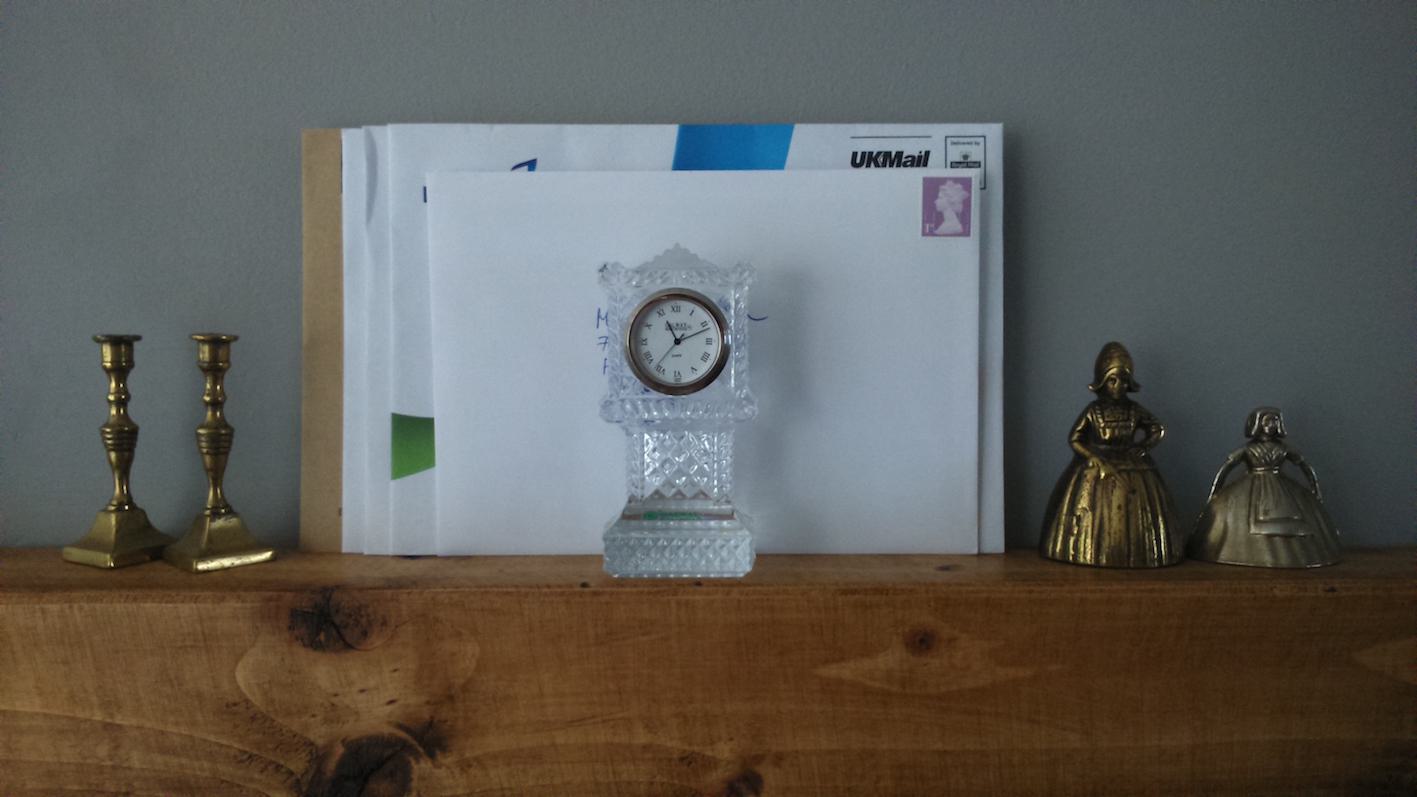
What do I mean? Well, you know how when you get home from holiday and find your doormat covered in flyers, ranging from an advert for the new Indian takeaway to a reminder about your local recycling scheme? Among all the detritus there are sometimes a few things you decide to keep so that you can do something about them later. You may have a special pile you keep them in or maybe you put them (literally or metaphorically) behind the clock on the mantelpiece.
And that was precisely what we needed to do with legacy marketing.
We didn’t know when our supporters were going to be moved to make a will, so we needed to get as many legacy messages out there as we could. Not in a way that could be accused of overkill, but in a way that meant the donor might put one of those messages behind the clock and then bring it out again at one of those life-stage triggers to making a will, before trotting along to the solicitor (or whoever) to make one.
We soon learned that these messages could be carried in all sorts of places and that they needn’t be long and costly communications. As well as our own bespoke legacy mailings, we could drip-feed messages about legacies through many other channels in our organisations. A paragraph in the annual report/review; a story of an ‘ordinary’ legacy pledger in a supporter magazine; a simple legacy message in the franking on our envelopes are just three of the hundreds of possibilities we all began to explore.
This meant that even those charities that didn’t have a budget for big campaigns could also get involved in some very effective legacy marketing. Even without wonderfully creative direct mail or award-winning TV ads they could get messages out there by cross-selling, riding on the back of other communications, and dropping legacy messages into as many situations as they could.
We learned that our legacy messages, as well as being compelling and memorable, should also be frequent and delivered through as many appropriate channels as possible.
Those who do have the big budgets (and the corresponding big targets, of course) can also benefit from this approach as it paints the background for their other campaigns and makes them even more effective.
So why should you be doing this, if you aren’t already?
Where ‘behind the clock’ legacy marketing is understood and employed it makes a huge difference. Less money is spent (wasted?) on inappropriate and ineffective messages and channels. More time and effort is spent on relationship building, getting the message out through other channels and engaging in ‘drip, drip, drip’ messaging. Less time and effort is spent on the ‘hit ‘em between the eyes/scare ‘em into making a will’ stuff we saw years ago.
We have to recognise that the decision to make a will and leave a legacy is often one that takes a long while – and requires a lot of different messages from us and from elsewhere – in order to come to fruition. But we have also to recognise that measuring the success of our legacy marketing activity is not as straightforward as some might like.
It’s all very well, for instance, to try to measure the success of a mailing by counting the enquiries and the pledges it generates. Tempting though this is, it fails to take into account the complexity of the legacy journey that many of our supporters are on. We need to remember that the mailing that generates X number of pledges and Y number of enquiries may well have been brilliantly crafted and accurately targeted – but its success will surely have been helped by the drip-feed work of getting legacy messages out and normalising legacy giving. This, of course, may have been going on for many months before the mailing was even a concept.
I should mention that all this cross-selling and persuading colleagues to carry legacy messages depends upon there being a high level of awareness of the importance of legacies within any given organisation. This will often only be achieved if there has been a sustained and effective internal legacy awareness campaign – but that is probably a subject for another day...
This idea was presented at IWITOT London in September 2015.