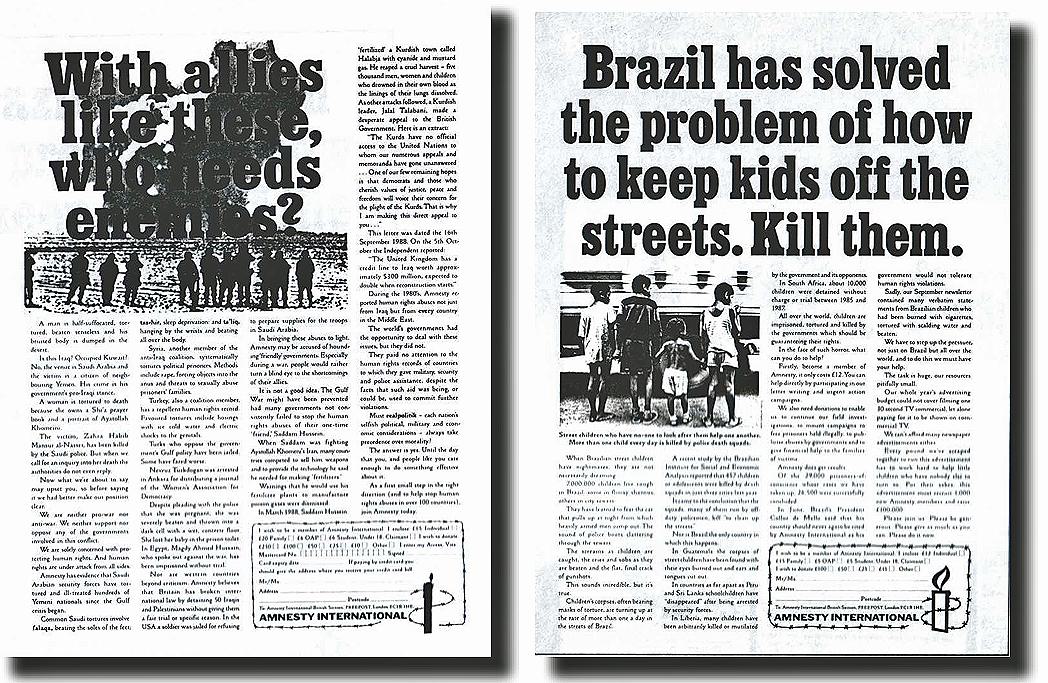
Amnesty Inter­na­tion­al UK: addi­tion­al infor­ma­tion on the press ads that shook a nation’

Written by
John Baguley
Added
May 22, 2012
From: John Baguley
To: carolina@sofii.org
Subject: Amnesty adverts update
I’ve just noticed the Amnesty International full-page ads on SOFII and your request for more information.
I was director of fundraising at Amnesty at that time and commissioned these ads from the agency Collett, Dickenson and Pearce (CDP) where Indra Sinha worked. He is now an author and his novel Animal’s People was on the 2007 Man Booker shortlist. Neil Godfrey was the art director.
The first advertisement in the series was a half-page test. The headline read ‘Brazil has solved the problem of how to keep kids off the streets. Kill them.’ It brought an immediate result in floods of new members and donations totalling more than the cost of the advert, which was unheard of for acquisition at that time. It also brought condemnation from the Brazilian government and the British Section of Amnesty amazingly agreed not to run the advert again. The killing goes on today – 20 years later.
Moving to full-page adverts proved even more profitable and one advert alone brought in 3,000 new members via the coupon response. Even adverts stating Amnesty could do nothing about a problem worked well. During the Gulf War I was requested to balance the advert featuring the gassing of Kurds at Halabja by looking at the allies and ran an advert asking ‘With Allies like these, who needs enemies?
’ The adverts provoked huge internal debate, moving Amnesty from being basically a research agency sending mild letters to offending governments to one campaigning forcefully on human rights. The only advert not to make it through the complaints was one mentioning Gandhi, on the spurious grounds it would offend Indians – Indra Sinha was not amused.
I hope this might add to the interest in the advertisements and wish I had kept the results.
Kind regards
John Baguley.

About the author: John Baguley

John Baguley is a management and fundraising consultant, and director of the International Fundraising Consultancy. He is the author of “Successful Fundraising” and has written extensively on fundraising, lectured and worked in all parts of the world. 

John is a former Fundraising Director at Amnesty International UK, Friends of the Earth and the Medical Foundation. He has worked for Oxfam and other international development organisations. 

John was the first Director of International Fundraising for Amnesty's International Secretariat, and the first Director of the Soil Association.

Recent Articles

You don’t have to choose between dignity and donations

Across the sector, organisations have been challenging stereotypes, questioning power dynamics and thinking more carefully about how to represent the people they help. This new report uses data to help you under­stand what donors think about the types of images used in fundrais­ing, and what that means for per­for­mance.

Read more

¿Qué es un agente fiscal y cuándo usarlo en la canalización de fondos de cooperación internacional?

A pesar de los cambios recientes, la cooperación internacional sigue movilizando cada año millones de dólares destinados a financiar proyectos de desarrollo, acción humanitaria y fortalecimiento institucional en todo el mundo. Sin embargo, muchas veces los recursos no llegan de manera directa a las organizaciones locales que implementan las iniciativas. Una de las figuras más utilizadas para canalizar estos fondos es la del agente fiscal (fiscal agent o fiscal sponsor en inglés). 

Read more

A softer year for giving – but four donor groups show us where there’s growth potential

Every year, Blue State releases their Giv­ing Behav­iours Track­er. In this article, Anjali Bewtra explains that the latest findings show the UK public is still profoundly generous, but increasingly selective about their donations. 

Read more

Diversificar ingresos: Más allá de los proyectos y donantes

Diversificar fondos o ingresos no significa simplemente buscar más donantes; eso solo perpetúa la lógica de financiamiento basada en proyectos. La verdadera diversificación implica ir más allá y construir un modelo que integre otras fuentes de ingresos además de los proyectos, como programas e ingresos propios o unidades de negocio. 

Read more

El sourcing en la cooperación: cómo ser una organización local visible y atractiva para financiadores

En la cooperación internacional y la filantropía, solemos pensar que son las organizaciones sociales las que buscan y compiten por acceder a fondos. Sin embargo, cada vez más, el proceso funciona en doble vía: los financiadores también hacen sourcing, es decir, buscan activamente socios locales sólidos, confiables y con capacidad de generar impacto real en los territorios o comunidades.  

Read more

Also in Categories