The ad that triv­i­alis­es tragedy

If you’ve ever walked with some­one as they descend­ed into demen­tia, you know it is one of the most gut-wrench­ing, anguish­ing things that can hap­pen. We should all fer­vent­ly hope and pray for treat­ments and a cure for Alzheimer’s disease.

Written by
Jeff Brooks
Added
May 14, 2013

And that’s clearly what the Alzheimer Society of Montréal wants too. But you can't really tell from this stupid ad:
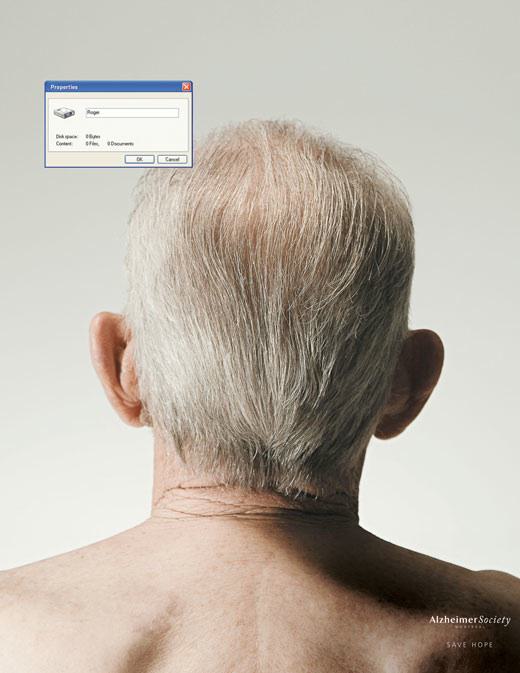
Here’s a detail, so you can see the ‘punch line’:

Alzheimer’s almost hits the category of ‘too scary to talk about’. And that might lead people to reach for metaphors and analogies to talk about the disease and what it does.

But this computer hard drive analogy is inept. Not only that, it’s glib and dehumanising. Roger, even if he’s in the late stages of Alzheimer’s, is not a blank hard drive. He’s still a human being.

Worse still, comparing the deep human tragedy of Alzheimer’s with the minor problem of a broken hard drive just pushes everyone further from understanding and caring about this disease. Losing a hard drive is a pain – possibly a huge pain. But it can’t even come close to comparing to the heartbreak, fear and pain of Alzheimer’s.

What someone should have asked is: What are we trying to accomplish? What action or attitude do we hope to engender with this message? It appears nobody asked that, so they ended up with a pointless and misleading analogy that trivialises the very thing the organisation is dedicated to fighting.

As you might expect, this is the work of an ad agency.

Thanks to Osocio for the tip.

About the author: Jeff Brooks

Jeff Brooks has served the nonprofit community for more than 30 years, working as a writer and creative director on behalf of a variety of organisations including CARE, World Vision, Feeding America, St. Jude Children’s Research Hospital, National Wildlife Federation, and many more. He blogs at Future Fundraising Now and Moceanic. In previous careers, he’s been an English teacher and a classical musician. He lives in Seattle in the USA.

Recent Articles

Open Letter to Tom Ralser re: The fallacy of ‘facts tell, stories sell’

Claire Axelrad responds to Tom Ralser’s opinion piece with an open letter. In it, Claire shares her perspective on storytelling, as a writer and fundraiser.

Read more

Matched funding challenge boosts Ken Burnett’s latest 500-mile quest

Thanks to the kindness and generosity of Chip Grizzard, the first £7,500 Ken raises will now be doubled! Could you help Ken reach his goal and raise even more for SOFII?

Read more

The fallacy of ‘facts tell, stories sell’

In a new addition to SOFII’s Opinions and Debates showcase, Tom Ralser shares his view on the notion that ‘facts tell, stories sell’. When it comes to fundraising, Tom feels that relying on stories alone isn’t always enough to create a great appeal AND convince your donor to give. 

Read more

Can fundraisers tell the difference between AI and human-written thank you letters?

Surprising survey results show that AI letters were rated higher by fundraisers than human-written letters. 

Read more

A medida que los donantes jóvenes empiezan a participar más, ¿están las organizaciones preparadas para ellos?

Las personas jóvenes están listas para apoyar a las organizaciones, pero la forma en la que te comunicas con ellas puede marcar una gran diferencia en que elijan o no tu causa. En este artículo, Anjali Bewtra de Blue State, comparte qué tomar en cuenta al comunicarse con este público, junto con ejemplos de entidades que ya lo están haciendo bien.

Read more

Also in Categories